
Radio production in IP workflow: RSI integrates ten studios with KSC Core
By integrating its radio production into a fully IP-based workflow, RSI is creating the foundation for a shared technical infrastructure for radio and television. The integration was based on KSC Core , which had already taken over the main television control room in 2022 and now serves as the central control level for both areas. The solution demonstrates how radio environments can be precisely integrated into existing IP production landscapes.

IP-based radio environment within the existing system network
RSI's radio production needed to be integrated into the existing IP infrastructure without disrupting existing TV operations. The goal was to manage radio studios, editorial offices, and the cross-media control center within a single control system. KSC Core was chosen again because the system is vendor-independent and already meets the requirements of TV operations. This allowed the entire technical environment to be consolidated on a common platform.
Advanced control functions for radio processes
For integration, several functions within KSC Core were further developed or newly implemented, including modules for codec handling, audio remapping, and the management of multiplex bus scenarios. In addition, the KSC DelegationManager was extended to reliably map studio handoffs and remote switching within the radio infrastructure. These adjustments make it possible to precisely control radio processes and embed them into the existing logic of TV workflows.
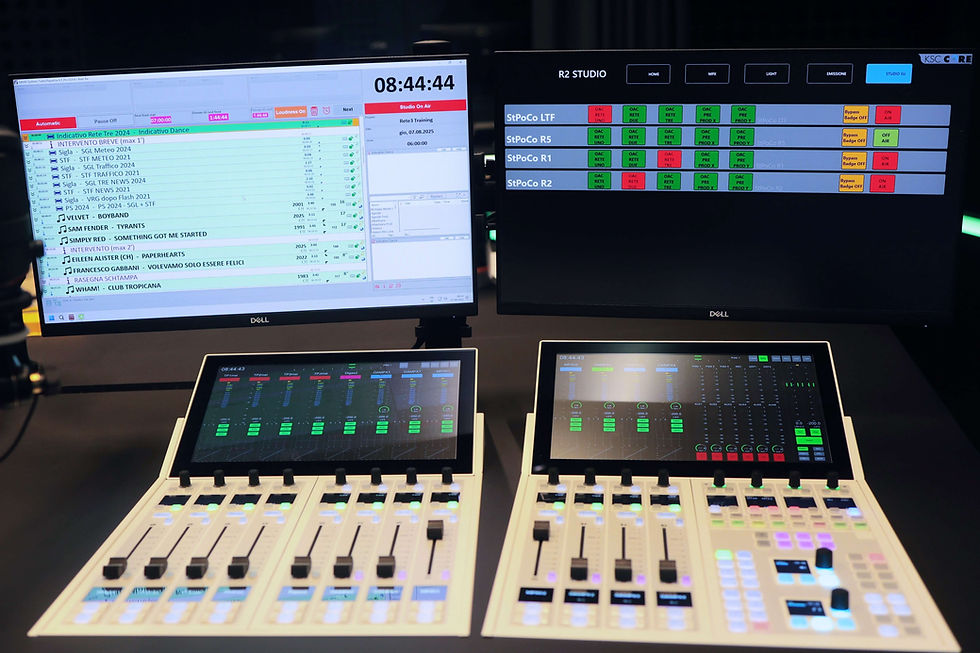
A key role was played by the KSC GFXUnit , which was configured for radio operation in collaboration with RSI. The interface provides studio functions such as routing, microphone parameters, and lighting control, and allows radio production to be operated from all workstations in the cross-media control room. The design was such that radio equipment could be integrated without any modifications to the existing TV infrastructure.
Control workstation with monitors for controlling and monitoring audio signals as well as a digital
Implementation during ongoing operations
The integration was implemented in several stages while the TV infrastructure remained in IP operation. This parallel expansion placed high demands on coordination between the engineering, operations, and integration teams. To ensure a predictable rollout, the entire range of functions was mapped in KSC Core early on, before the studios went live.
In practical application, it became clear that radio processes could be precisely adapted to the respective workflow using the GFXUnit. This enabled a rapid switch between test and live operation without changing existing paths or configurations in the TV area.
Structure of the new radio environment
The project integrated ten radio studios , including a Visual Radio Studio (R4W), three editorial offices , and an audio platform with 20 processors into the system. Within KSC Core, more than 2,500 logic modules and over 250 processes were implemented to control routing-related, organizational, and studio-wide workflows. SLG Broadcast AG acted as the general contractor for the audio equipment installation, while the control logic was implemented entirely within KSC Core.
Further development of KSC Core in the radio sector
RSI's requirements led to several targeted enhancements within KSC Core. These include new radio modules, improved delegation mechanisms, and more precise logic for cross-studio scenarios. The implementation demonstrates that KSC Core is not only suitable for TV workflows but also for complex radio environments, uniting both worlds on a single technical foundation.
Outlook
RSI is currently working on further IP projects, including the conversion of TV control rooms A and B to an IP-based infrastructure – also controlled by KSC Core. The experience gained from the radio project is being directly incorporated into these next steps and demonstrates how KSC Core is establishing itself as a central control instance for cross-media production environments.


